
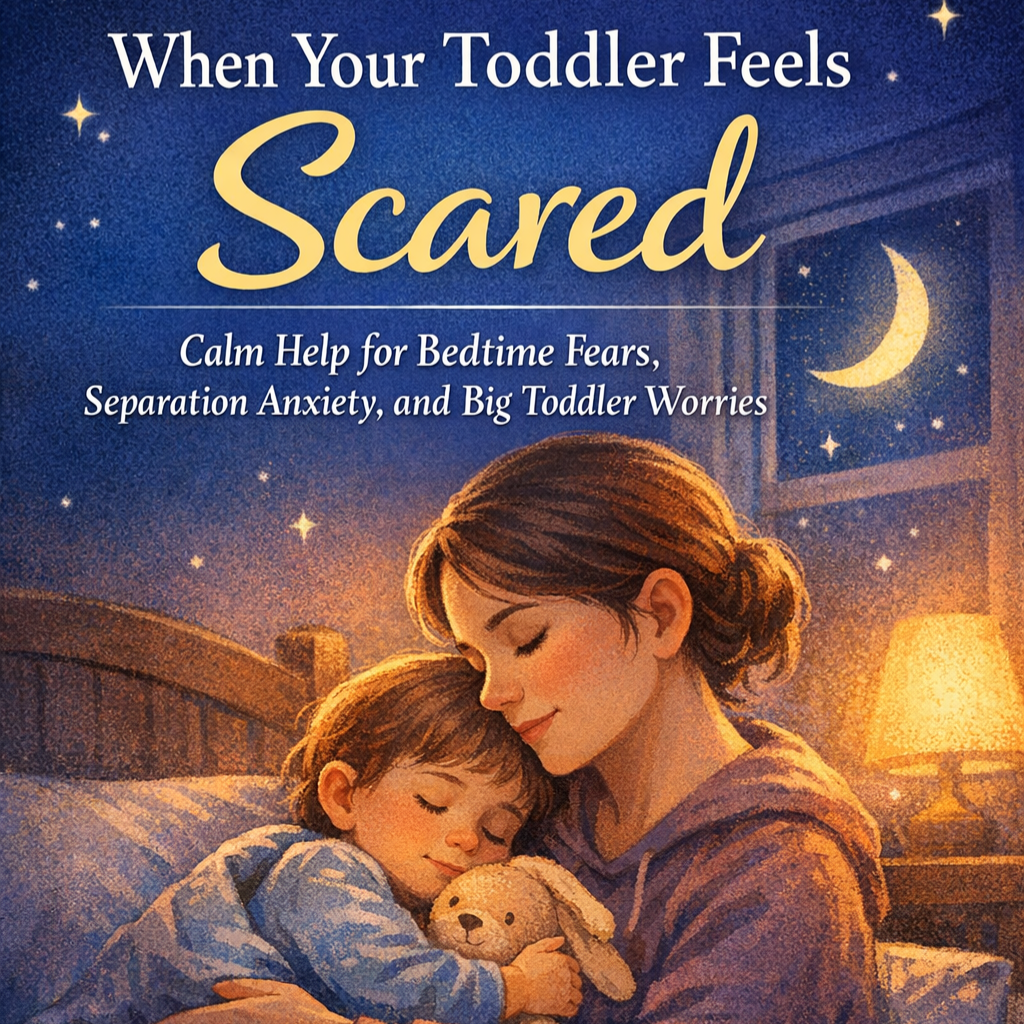
You do not have to make every fear disappear to help your child feel safer.
Bedtime suddenly feels scary. Drop-off turns into clinging. A loud sound, a dark room, a new place, or the thought of you leaving becomes enormous.
When Your Toddler Feels Scared gives parents of children ages 2–5 a calm plan for those tender moments — with reassurance, boundaries, practical scripts, and support for building brave skills gradually.
Inside the guide
- A practical explanation of common toddler fears and why logic often does not help at the peak of fear.
- A Calm Fear Response for moments when your child is scared right now.
- Scripts for bedtime fears, separation, loud sounds, new places, refusal, and fear that shows up as anger or control.
- A Bedtime Fear Mini Plan and a Separation Support Plan.
- Ways to support bravery without forcing, shaming, or rushing your child.
- Support for your own guilt, overwhelm, and second-guessing.
- Printable tools including a fear-script cheat sheet, response flowchart, pocket reminder, and repair scripts.
What it can sound like
Bedtime fear: “That feels scary. You’re safe here. I’m going to help you settle.”
Separation: “You don’t want me to go. Your teacher will stay with you, and I will come back after lunch.”
Fear and refusal: “You’re worried about going in. We’re still going, and I’ll help you take the first step.”
This is for you if…
- Bedtime fear or separation has suddenly become a major struggle.
- Your child repeatedly asks for reassurance and you are unsure how much is enough.
- Fear sometimes turns into refusal, anger, or controlling behavior.
- You want to comfort your child while still helping life move forward.
Fear does not need shame, and bravery does not need force. It grows through safety, support, and small manageable steps.
Digital product. This guide is educational and is not a substitute for individualized medical or mental-health care.



Reviews
There are no reviews yet.