
The version that actually works in a home
Gentle Parenting Pros and Cons: The Strengths, Limits and Common Traps
Gentle parenting can make family life more respectful and less fear-driven. It can also become exhausting when parents mistake “gentle” for endless patience, endless explanation, or never letting a child feel disappointed.
The balanced answer
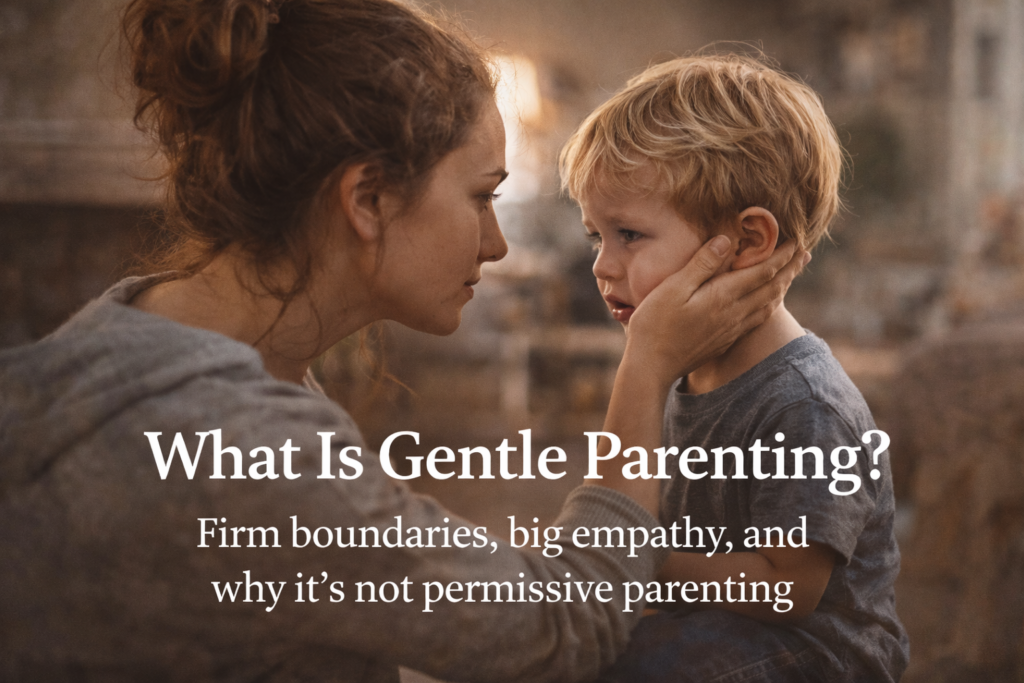
There is a lot to like about gentle parenting when the phrase means: respect the child, understand development, use less shame and fear, hold clear limits, and repair mistakes.
There is also a lot to dislike when the phrase turns into: never upset the child, never use a firm voice, explain every rule until the child agrees, and treat normal parental frustration as failure.
The strongest version of gentle parenting is not softer leadership. It is calmer, more respectful leadership.
Pro #1: It separates feelings from behavior
“You can be angry. I won’t let you hit.”
That distinction is powerful. Children do not have to stop feeling something before the adult can keep everyone safe.
It also prevents a common message: big feelings make you bad.
Pro #2: It reduces reliance on fear and shame
A boundary does not need humiliation to become real.
You can remove a thrown toy without saying, “What is wrong with you?”
You can leave the playground without threatening to never come back.
You can stop hitting without calling the child naughty.
The parent still acts. The extra emotional punishment is what disappears.
Pro #3: It makes repair normal
Parents are human. A parenting philosophy that only works if the adult never loses patience is not very useful.
Gentle parenting at its best gives parents somewhere to go after a mistake:
“I yelled. That was my responsibility. I’m sorry. I’m going to try again.”
Repair does not erase harm, but it is far more realistic than pretending good parents never get it wrong.
Pro #4: It keeps development in the picture
A toddler is not a small adult with worse manners.
Impulse control, emotional regulation, language, and flexibility are still developing. Understanding that can change the question from “How do I make this child obey?” to “What skill or support is missing here, and what boundary still needs to happen?”
Pro #5: It can make boundaries clearer
This may sound strange because gentle parenting is often accused of weak boundaries.
But when parents stop threatening unrelated punishment and start using direct follow-through, boundaries can actually become simpler:
“I won’t let you throw the truck. I’m moving it.”
No lecture. No future threat. Just a clear limit connected to the situation.
Con #1: The label is incredibly vague
There is no single gentle-parenting handbook everyone follows.
Online, the same label can describe:
- clear, developmentally informed parenting
- authoritative parenting with softer language
- attachment-oriented practices
- highly permissive parenting
- social-media scripts with no follow-through at all
That makes blanket claims about “gentle parenting” difficult. Always look at the actual practices underneath the label.
Con #2: It can create impossible pressure to stay calm
Parents can start believing that if they sound irritated, they have failed.
That turns the approach into another source of guilt.
Your child does not need you to perform perfect serenity. They need you to keep working toward safe, respectful behavior, and to repair when you miss.
Con #3: Validation can become a five-minute speech
A dysregulated toddler usually does not need:
“I understand that you are feeling really disappointed because your brother had the green cup and perhaps that made you feel unseen…”
They may need:
“You wanted the green cup. He’s using it. You can have blue or wait.”
Warm does not have to mean wordy.
Con #4: Parents can forget to lead
This is the trap CLH focuses on most.
You validate. You state the boundary. Then your toddler ignores you.
What happens next?
At Calm Little Home, gentle parenting includes the Lead step.
Connect: “You wanted to stay.”
Limit: “It’s time to leave.”
Lead: “Walk with me, or I’ll help you to the car.”
Con #5: It can drift into permissiveness
If every strong protest changes the answer, the child learns that the boundary is still under negotiation.
Permissiveness is not kindness. It can leave both child and parent unsure about who is responsible for the decision.
For a deeper comparison, read gentle parenting vs permissive parenting.
Con #6: The advice can ignore parental capacity
“Stay calm and co-regulate” is much easier to write than to do after broken sleep, work, cooking, noise and a preschooler yelling because the toast was cut wrong.
Good parenting advice should account for the adult too. Sometimes the most useful plan is fewer words, a simpler routine, more environmental support and a repair afterward.
A quick reality check
| Common trap | Gentle-and-firm alternative |
|---|---|
| Ask until the child agrees | State the limit and follow through |
| Stop every tear | Allow disappointment while staying close |
| Never get angry | Manage anger safely and repair mistakes |
| Explain until they accept | Give enough information, then act |
Who controls what?
The parent controls: safety, reasonable limits, routines, follow-through, and their own behavior.
The child controls: whether they like the limit, whether they cry, and how quickly they recover.
That split removes a huge amount of unnecessary pressure.
So, is gentle parenting a good idea?
It depends on what you mean by it.
If you mean dignity, developmentally appropriate expectations, connection, clear boundaries, and less shame: those are useful principles.
If you mean never saying no, never frustrating your child, and endlessly negotiating until everyone is calm: that is likely to exhaust the adult and confuse the boundary.
FAQ
Is gentle parenting permissive?
It should not be. A child can be upset and the boundary can stay.
Can gentle parents use consequences?
Yes. Related, proportionate consequences and direct follow-through can fit easily within gentle parenting.
What if gentle parenting feels too hard?
Simplify. Use fewer words, clearer limits, and more realistic expectations. You do not need to narrate every emotion or handle every moment perfectly.
Bottom line
Keep the respect. Keep the empathy. Keep the repair. Drop the fantasy that a good boundary must produce a happy child, and do not forget to lead.
If you want the version of gentle parenting that keeps the warmth and the adult leadership, The Gentle Leader puts the complete CLH framework into one 12-chapter guide for real family life. It is free for new subscribers.