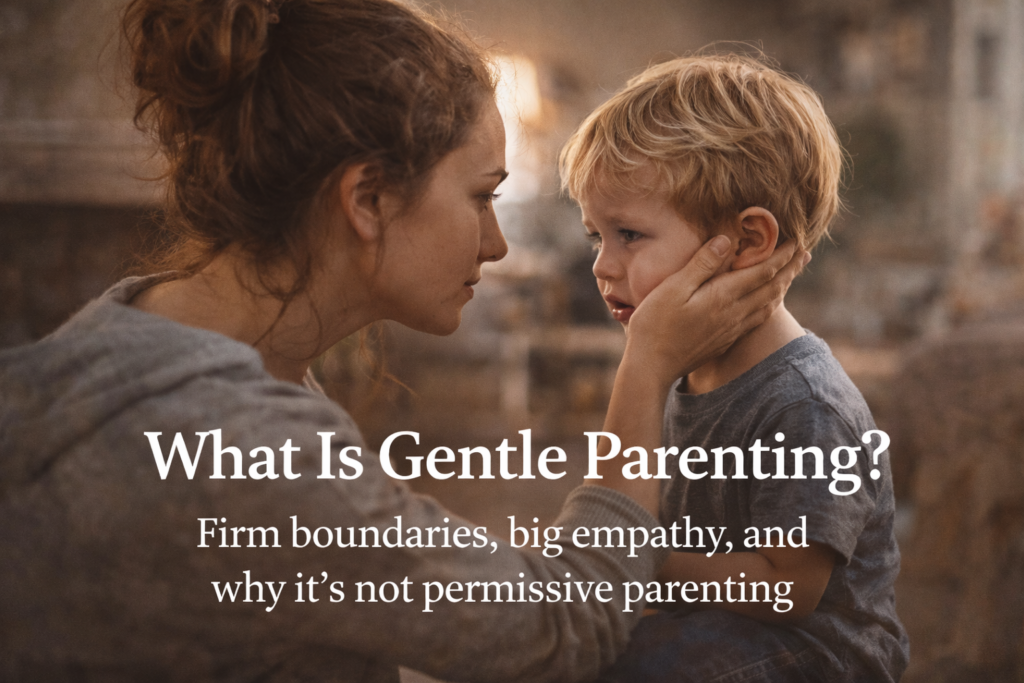

What does gentle parenting actually look like?
Gentle Parenting Examples: 12 Real-Life Moments From No to Meltdowns
The useful part is not the validating sentence. It is what the parent does after the sentence. These examples show warmth, limits and actual follow-through.
The simple pattern: Connect → Limit → Lead
Gentle parenting gets vague very quickly when examples stop at: “I see you’re upset.”
At Calm Little Home, we use three steps:
- Connect: notice the experience.
- Limit: make the boundary clear.
- Lead: help the next step happen.
For the full foundation, read What Is Gentle Parenting?
A successful gentle-parenting moment does not always end with a calm child. Sometimes it ends with a crying child and a boundary that still happened safely.
1. Leaving the playground
Your child sees no reason why the best part of their day should end because you have decided dinner exists.
Connect: “You wish we could stay.”
Limit: “It’s time to go.”
Lead: “You can walk beside me or I’ll help you to the car.”
If they collapse onto the ground, you do not need to invent a better reason. Help them leave.
2. Hitting when angry
Connect: “You’re furious he took the truck.”
Limit: “I won’t let you hit.”
Lead: Block the hit or separate bodies. “I’m moving you back. I’ll help keep everyone safe.”
Later, teach “stop,” “my turn,” or getting an adult. See our toddler hitting guide.
3. Asking for another cookie
Connect: “You really want another.”
Limit: “Cookies are finished for today.”
Lead: “You can have yogurt, or wait for dinner.”
The child may reject both. That does not mean another cookie becomes the third option.
4. Bedtime refusal
Connect: “You want more play.”
Limit: “It’s bedtime.”
Lead: “Do you want to hop or tiptoe to the bathroom?”
If they refuse both: “You don’t want either. I’ll help you walk.” Choices are tools, not loopholes.
5. Refusing both choices
This deserves its own example because it trips up so many parents.
Parent: “Red cup or blue cup?”
Child: “NO CUP!”
Parent: “You don’t want either. I’ll use the blue cup.”
The choice gave autonomy. It did not transfer the entire decision.
6. Screen time ends
Connect: “You wanted another episode.”
Limit: “Screen time is finished.”
Lead: “I’m turning it off now. You can be mad. Snack is next.”
If the child grabs the remote: “I won’t let you throw it. I’m moving it somewhere safe.”
7. Throwing a hard toy
Connect: “You’re frustrated.”
Limit: “I won’t let you throw hard toys at people.”
Lead: Move the toy. “You can throw this soft ball in the basket.”
If the child is still throwing, reduce access to hard objects until they are regulated.
8. Sibling grabs a toy
Two children are pulling the same toy and both are yelling.
Connect: “You both really want it.”
Limit: “I won’t let you pull it from each other.”
Lead: “I’m holding the toy while we figure out what happens next.”
You do not have to solve ownership while hands are still fighting.
9. Public meltdown in a shop
Your child wants a toy. You said no. Now they are on the floor and people are looking.
Connect: “You really wanted it.”
Limit: “We’re not buying it.”
Lead: “We’re leaving the shop now. I’ll help you outside.”
The audience does not change the boundary. Your job is not to perform calm parenting for strangers. It is to help your child through the moment.
10. “I HATE YOU!” after you say no
Connect: “You’re really angry with me.”
Limit: “You can be angry. The TV is still off.”
Lead: “You can say, ‘I’m mad at you.’ I’m staying nearby.”
You do not have to debate whether they literally hate you while they are dysregulated.
11. You yelled
Gentle parenting also includes what happens when you are the one who messed up.
“I yelled. That was not how I want to speak to you. I’m sorry. I’m going to try that again.”
Then, if relevant: “And I still won’t let you hit.”
Repair does not require undoing the original boundary.
12. Your toddler refuses to get dressed
Connect: “You want to stay in pajamas.”
Limit: “We need clothes before we leave.”
Lead: “Red shirt or blue shirt? If you don’t choose, I’ll choose and help.”
If clothing is a daily battle, also check sensory discomfort and transition timing rather than assuming every refusal is defiance.
Harsh vs permissive vs gentle-and-firm
Harsh: “Stop crying or we’re never coming here again.”
Permissive: “Okay, five more minutes,” because the protest became intense.
Gentle-and-firm: “You wanted to stay. We’re leaving. I’ll help you.”
What the parent controls, and what they do not
You control: whether the reasonable limit happens, how safely you carry it out, whether you add shame, and whether you repair your own mistakes.
Your child controls: whether they like the limit, whether they cry, and how quickly they recover.
Trying to control the second list is where many gentle parents burn out.
Three examples where the best answer is fewer words
Sometimes the gentlest response is not a perfect script.
Child is screaming and trying to hit: “I won’t let you hit.” Block. Stay close. That may be enough.
Child is sobbing at bedtime: “I know. I’m here.” You do not need to narrate every emotion.
Child is refusing to leave: “It’s time. I’ll help.” Then help.
When your child ignores the boundary
Do not keep repeating the same sentence louder. If the boundary matters, move from words to action. Our guide to gentle parenting follow-through explains that step in detail.
FAQ
Do I have to validate every feeling?
No. Sometimes “I know” or quiet presence is enough. Validation is not a script quota.
What if empathy makes my child more upset?
Use fewer words. Some children do not want their feelings narrated in the middle of a meltdown.
What if my child never chooses?
You choose. Necessary transitions do not need to wait indefinitely for a toddler decision.
What if the gentle script does not stop the behavior?
Then the next step is not a better script. It is follow-through: block, move, help, remove access, or complete the necessary transition.
Keep the formula simple
See the feeling. Keep the limit. Help the next step happen.
If these examples make sense but you want the bigger framework behind them, The Gentle Leader covers boundaries, big feelings, transitions, follow-through, repair and what to do next across the toddler and preschool years. New subscribers can get the complete 12-chapter guide free.