Safety first. Shame never.
Gentle Parenting Toddler Biting: Stop the Bite Without Shame
When a toddler bites, “gentle” does not mean standing nearby calmly narrating feelings while someone gets hurt. Stop the bite first. Then help with the feeling, the impact, and the missing skill.
The first job is not teaching. It is stopping the bite.
Biting can trigger a huge reaction in adults. It looks aggressive, it can leave a mark, and if another child is involved you may instantly feel embarrassed, angry or worried about what everyone thinks.
But in the actual moment, your toddler needs you to become very simple.
“I won’t let you bite.” Block, move bodies apart, or gently move your child away from the person they are biting.
You do not need a lecture. You do not need “Why would you do that?” You do not need to make them say sorry before you have even checked the child who was hurt.
Attend to the hurt person first
One common mistake is giving the biting child so much attention that the child who was bitten becomes almost invisible.
If someone was hurt, calmly help them first. Check the injury, comfort them, and get whatever care is needed.
Your toddler can stay close if that is safe, but they do not need to become the center of the scene.
Then use Connect → Limit → Lead
Once immediate safety is handled, you can put a few words around what happened.
Connect: “You were so mad when he took the truck.”
Limit: “I won’t let you bite.”
Lead: “I’m moving you back. I’m helping your brother first. Then I’ll help you.”
This is gentle parenting without permissiveness: the feeling is allowed; the bite is still stopped.
Why toddlers bite
There is rarely one single reason. Biting can happen because a toddler:
- is frustrated and has very few words available in the moment
- wants a toy or space immediately
- is tired or overstimulated
- is crowded by another child
- is excited and impulsive
- is experimenting with cause and effect
- has sensory or oral-seeking needs
Understanding the pattern helps you prevent the next bite. It does not make the current bite acceptable.
Teach the replacement when everyone is calm
A toddler who is already biting is not in the ideal state for a lesson on conflict resolution. Teach later, when their brain has more room.
Keep the replacement tiny and physical:
- “Stop!”
- “My turn.”
- “Move please.”
- Come get an adult.
- Stomp feet.
- Push hands against a wall.
- Move away from the other child.
Then practice. You can make it playful: “I’m reaching for your truck. Show me what you can say instead of biting.”
What repair can look like without a forced apology
“Say sorry!” often produces a child who mutters the word while still furious. That is not necessarily repair; it is compliance.
Instead, help your child participate in making things better when they are ready:
- bring an ice pack
- help rebuild something that was knocked over
- offer the other child space
- ask, “Are you okay?” if they are able
- practice the words they can use next time
You can model the language too: “He got hurt when you bit. I’m helping him feel better.”
A real-life sibling example
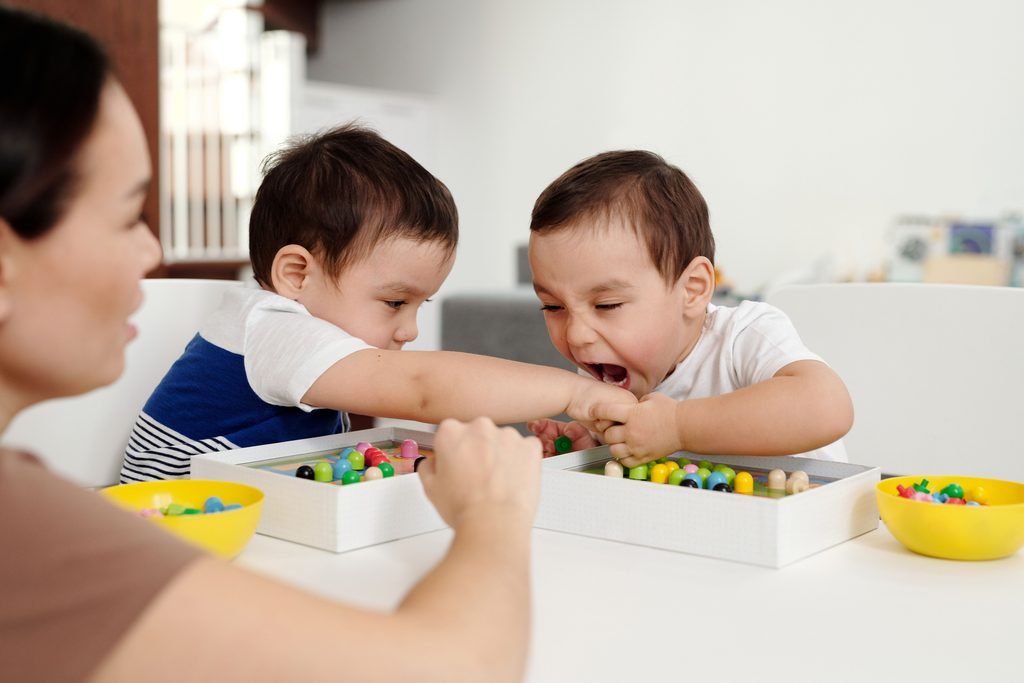
Your four-year-old grabs the baby’s toy. The toddler lunges and bites.
Parent: “I won’t let you bite.” Separates them.
Parent to hurt child: “That hurt. I’m right here. Let me see.”
Once things settle:
Parent: “You were angry when he took your toy. Biting hurts. Next time say ‘mine,’ ‘stop,’ or come get me. Let’s practice.”
If the toy situation is still too charged, the adult may hold the toy or move both children into separate activities for a while. The priority is not getting them to play beautifully together five seconds later. It is restoring safety.
What not to do after biting
- Do not bite back. It teaches exactly the action you are trying to stop.
- Do not label the child. “You’re a biter” turns a behavior into an identity.
- Do not force affection. A hug should not be the price of repair.
- Do not give a long shame speech. “Look what you did!” rarely builds the skill you need next time.
- Do not rely on empathy alone. “You were mad” needs to be followed by an actual safety limit.
Look for the moment before the bite
If biting happens repeatedly, keep a simple mental or written note:
- What happened right before?
- Who was close?
- Was there a toy conflict?
- Was your child tired or hungry?
- Was the room noisy or crowded?
You may start noticing that biting is most likely during one predictable kind of situation. Prevention becomes easier when you can get physically closer before the conflict peaks.
Biting and other unsafe behavior
The same CLH principle applies to hitting, kicking and throwing: feelings are allowed, unsafe behavior is physically prevented when necessary, and teaching happens once the child can receive it.
If hitting is part of the pattern too, see what to do when your toddler hits.
When to get extra support
Occasional biting can be part of toddler development, but frequent or severe biting deserves closer attention. If bites regularly break skin, happen across many settings, seem difficult to interrupt, or come with broader developmental or communication concerns, discuss the pattern with an appropriate pediatric or child-development professional.
FAQ
Should there be a consequence?
The immediate consequence is already logical: the biting situation stops, bodies are separated, and access to the conflict may pause until safety is possible. You usually do not need to add an unrelated punishment on top.
Should I make my child apologize?
You can encourage and model repair without demanding a performance. The long-term skill is noticing impact and learning what to do differently next time.
What if they bite again five minutes later?
Increase supervision and reduce the opportunity. Your child may need you physically closer during the trigger situation rather than a stronger speech afterward.
Final takeaway
Your toddler can be struggling, overwhelmed or furious, and you can still stop the bite immediately. Compassion and safety belong in the same response.
If biting is part of a bigger season of hitting, big feelings and difficult limits, The Gentle Leader gives you the complete CLH framework for safety, boundaries, replacement skills and repair. New subscribers can get the full 12-chapter digital guide free.