
Gentle Parenting Foundations
9 Gentle Parenting Myths That Make Parenting Harder Than It Needs to Be
Gentle parenting becomes exhausting when “be respectful” quietly turns into “never upset your child.”
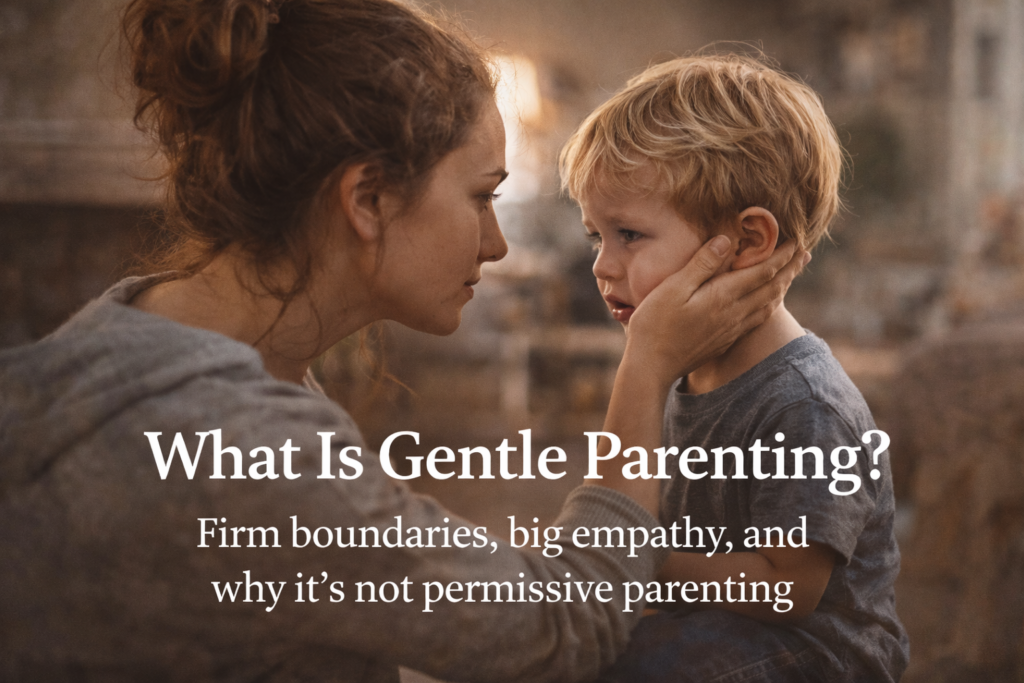
Short answer: gentle parenting does not require avoiding no, consequences, anger, conflict or child disappointment. It means handling those realities without humiliation, fear or unnecessary control.
You say bedtime is here. Your toddler cries. Somewhere in the back of your mind, a social-media voice whispers: Maybe I did not validate enough. So you explain more. Offer another choice. Add another cuddle. Suddenly it is 9:17 and everyone is less gentle than when you started.
The problem is often not gentleness. It is a myth about what gentleness requires. Our Calm Little Home guide to gentle parenting defines the approach as warmth plus leadership, not warmth instead of leadership.
Myth 1: A gentle parent should keep the child happy
Children are allowed to be disappointed. Your job is not to erase every hard feeling. It is to help them move through feelings safely while you make the decisions that belong to you.
“You wanted another episode. You’re disappointed. TV is finished. You can turn it off or I will help.”
Myth 2: You should never say no
A clear no can be kinder than a vague maybe that becomes ten minutes of negotiation. You can say no without shaming: “No, we’re not buying that today. You really like it.”
Myth 3: Validation should make the tantrum stop
Validation is not a calming trick. “You really wanted the red cup” tells your child you understand. It does not obligate them to stop crying. If the boundary is still red cup unavailable, the next step is leadership, not a better validation sentence.
Myth 4: Consequences are ungentle
Retaliation and humiliation are different from connected follow-through. If a toy is repeatedly thrown at someone, moving the toy is a real consequence tied to safety. If water is dumped, helping wipe it up connects action and repair.
Myth 5: A boundary is a sentence
“Stop hitting” is information. “I won’t let you hit; I’m moving back and blocking your hand” is a boundary with action. This is why our toddler hitting guide focuses on stopping the hit before teaching.
Myth 6: Good gentle parents never yell
Parents have nervous systems too. The standard cannot be permanent serenity. When you yell, repair what belongs to you, reconnect, and repeat the boundary calmly if it still matters. Repair after yelling is part of real family life.
Myth 7: Every choice empowers a child
Choices help when both options are real. “Shoes or boots?” can be useful. “Do you want to leave the playground?” is confusing if leaving is not optional. Too many choices can also add pressure when a child is overwhelmed.
Myth 8: If your toddler still cries, the approach failed
Success is not measured by a child’s immediate happiness. A successful boundary can include crying. A successful bedtime can include protest. A successful departure can include being carried to the car.
Myth 9: Gentle parenting means the child leads
Children need agency in age-appropriate places and adult leadership in adult-responsibility places. The parent decides safety, health, schedules and non-negotiable family limits. The child can have feelings and choices inside that structure.
The CLH replacement: Connect → Limit → Lead
Connect: “You wanted to stay.”
Limit: “It’s time to leave.”
Lead: “You can walk beside me or I’ll help you to the car.”
The sequence does not promise a smiling child. It gives the parent a way forward that protects both relationship and boundary.
Gentle, permissive and harsh are not the same thing
| Harsh | Permissive | Gentle + firm |
|---|---|---|
| Control the feeling and behavior | Avoid the upset by moving the limit | Allow the feeling, guide the behavior |
| Threaten | Negotiate endlessly | State and follow through |
For the deeper distinction, see gentle parenting vs permissive parenting.
FAQ
Does gentle parenting mean no punishment?
CLH favors teaching, safety and connected consequences over punishment designed to cause suffering or shame. That still leaves plenty of room for firm follow-through.
Can my child be mad at me?
Absolutely. A secure relationship does not require constant agreement.
What if empathy makes behavior worse?
Empathy may not be the problem. Check whether the limit and lead steps are missing, or whether your child is too overwhelmed for many words. Our tantrum vs meltdown guide can help.
Keep Reading
Want the myths replaced with a practical framework?
The Gentle Leader brings gentle parenting without permissiveness into one complete 12-chapter guide for boundaries, big feelings, transitions, follow-through and repair. New subscribers can get the full digital book free.