Calm Little Home · Big Feelings
The heart of it: Sometimes children know exactly what they want but cannot get the words out before frustration takes over. Our job is not to demand a perfect explanation in the middle of the storm. It is to make room for the feeling now, then practice a small, usable way to ask for help next time.
A few days ago, I arrived at preschool to pick up my son. The children had just discovered some outfits they could try on. He was excited. He had been waiting for his turn, and then I appeared in the doorway before he got the chance.
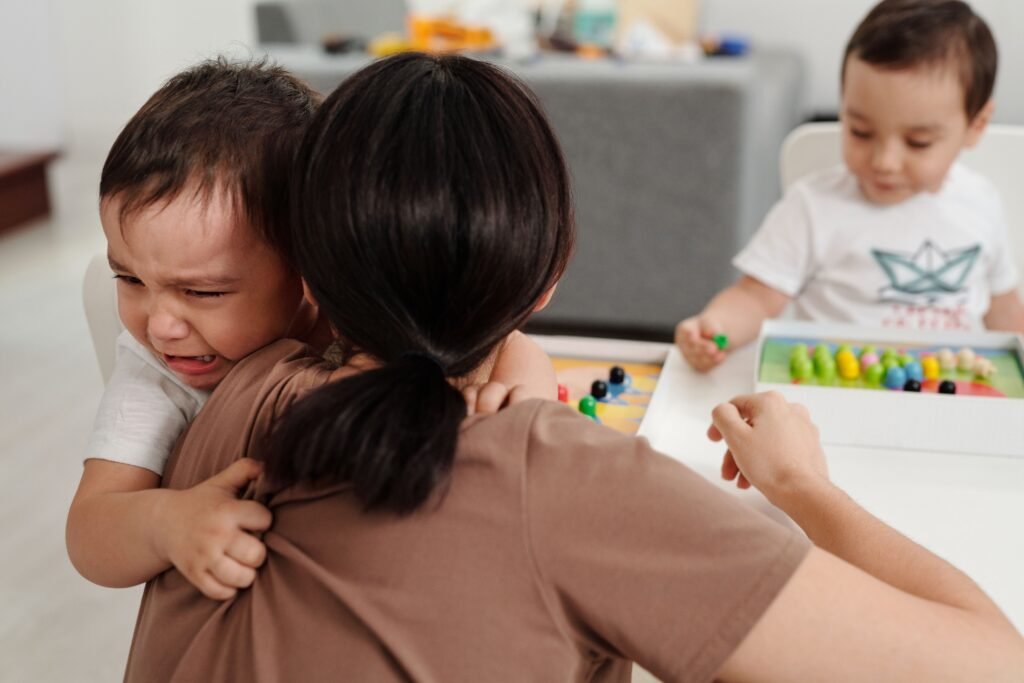
He burst out at me: he was shouting at me to leave. I tried to explain that I could wait in the corridor while he tried one on. It was a simple solution. From my side, nothing needed to be a problem.
But he was already too upset to take it in. The words I was offering were not landing.
And afterward, I kept thinking about how familiar that moment felt. Something happens, he reacts immediately, and only later do I understand what he was trying to tell me. By then, we have both spent energy on a conflict that neither of us wanted.
Perhaps you have stood in a doorway, kitchen, or parking lot with the same question in your mind: If I could just understand what you wanted, I might be able to help.
Why children sometimes react before they speak
Learning to notice a need, find words for it, manage disappointment, and listen to another person’s reply requires several skills working together. Preschoolers are still practicing all of them. Even a child who can hold a wonderful conversation at breakfast may struggle to find one useful sentence when upset.
There may be sadness, urgency, surprise, excitement, or worry underneath the outburst, not only anger. In our pickup moment, he was excited to try something and suddenly afraid the chance had disappeared. I could see a possible solution, but he could not yet use it.
This does not mean every outburst has a hidden meaning or that we should become mind-readers. It means behavior sometimes arrives before a clear request.
In the moment: connection before discussion
When a child is shouting, it is tempting to ask, “What do you want? Just tell me!” The request makes sense. Unfortunately, it can feel like one more task for a child who is already overwhelmed.
Try making your first response smaller: lower your voice, come down to their level if they welcome it, and name what you can actually see.
At preschool pickup: “You weren’t finished. You really wanted to try it on.”
Then: “I’m here. We can work out what happens next.”
If they are still shouting: “I’ll wait here. You can show me or tell me when you’re ready.”
A child might need space rather than touch, and you may need to leave on time. Calm support is not a promise that every plan can change. You can be kind and still say, “We can’t stay today. I know that’s disappointing.”
The skill to practice later: a signal before the full sentence
After everyone is calm, forget the long lecture. Begin with a tiny, repeatable phrase a child can reach for when words start disappearing.
Try one of these first: “Wait, I need something.” “I’m not ready.” “I want a turn.” “Help me tell you.”
If talking is hard, agree on a simple hand signal that means, “Please wait, I’m trying to tell you.” The signal is a bridge to communication, not a requirement before you offer help.
Choose just one phrase for the next few days. Model it yourself: “I need a moment to think,” or “Wait, I want to finish this first.” Children are learning from the small exchanges they hear all day.
Rehearse the exact situation, without making it a test
Later that evening, you might return to the preschool moment gently: “You wanted to try the outfit before we left. When I arrived, it felt like you might miss your turn.” Pause. Let your child correct you if that was not the whole story.
Then offer the words: “Next time you could say, ‘Can you wait outside? I want to try this first.’” Play the parent and let your child practice saying it, or pointing to the corridor. Switch roles if that makes it fun. Two minutes is enough.
The important part is the repetition across easy moments, not getting a performance right on command. You can practice with a toy that is out of reach, a game someone interrupts, or a parent arriving before a story is finished.
Make pickup easier before emotions rise
Prevention matters. Before you enter the room, you may be able to offer a little predictability: tell your child what happens at pickup, make room for a brief “show me one thing” moment when time allows, and agree with the preschool staff on how to handle unfinished activities.
For a child who struggles with sudden endings, a short ritual can help: hello, one thing to show, shoes, goodbye. It is not a guarantee against upset. It simply removes one surprise.
What progress really looks like
At first, your child may still shout and only find the words afterward. That counts as practice. Then one day they may say, “No! Wait!” before the shouting. Later, perhaps: “I wanted to finish.” These small changes are meaningful, even if big feelings still show up.
You do not need to turn every upset into an emotional vocabulary lesson. Notice one moment of effort and reflect it back: “You told me you wanted another turn. That helped me understand.”
And when the moment goes badly? You can try again. A child can be upset and still be learning.
Tonight’s one small step: Pick one phrase, “Wait, I need something”, and use it out loud yourself. Don’t wait for the next meltdown to introduce it.
For further reading on emotion coaching and helping children find words for big feelings, see the American Academy of Pediatrics and ZERO TO THREE.
Small steps are still progress.
Calm Little Home is here for real family moments, not perfect ones. Explore gentle parenting support and practical resources for the days that feel hard.
Explore Calm Little Home