Calm Little Home · Connection & Independence
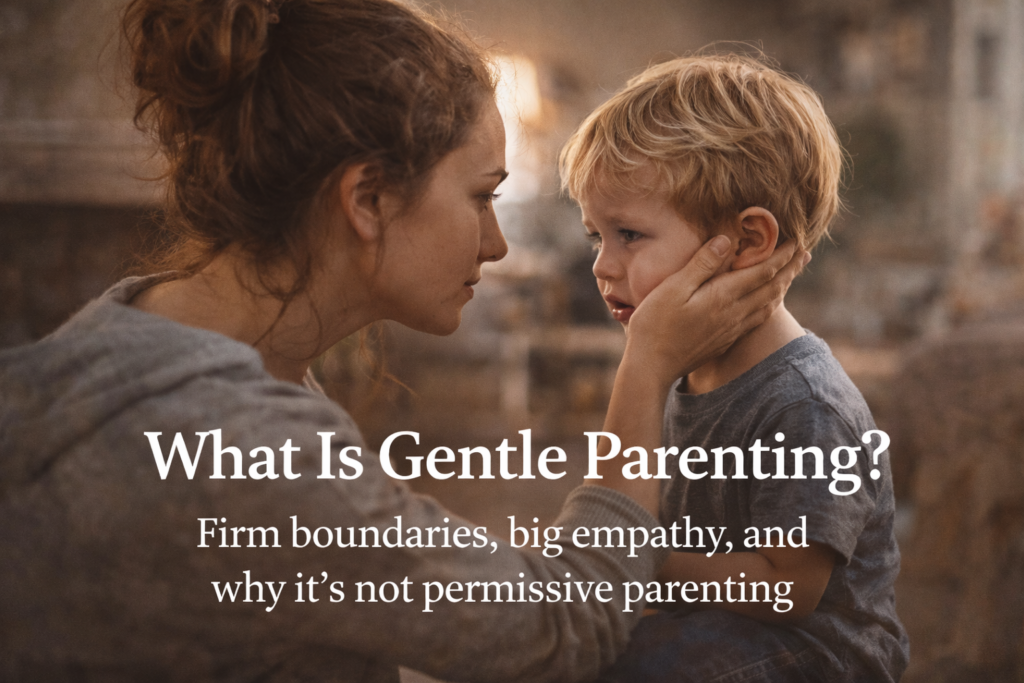
Short answer: If your toddler wants to be carried everywhere, it usually does not mean you have created a bad habit. Being carried can offer closeness, safety, rest, and reassurance. You can respond warmly while still setting limits around when your body is available to carry.
CLH at a glance: Wanting to be carried can mean tiredness, connection, or transition. Offer closeness, protect your body, and use clear endpoints so the limit feels predictable.
You put your toddler down.
They immediately reach both arms up.
“Carry me.”
You carry them to the kitchen, put them down again, and hear:
“UP!”
By lunchtime your arms hurt, your back hurts, and you are starting to wonder whether saying yes has somehow made the problem worse.
This is where a lot of parents get stuck between two uncomfortable ideas:
- “If I keep carrying them, they will never learn to walk on their own.”
- “If I say no, I am rejecting their need for connection.”
You do not have to choose either extreme.
You can meet the need for closeness without making your body available for unlimited carrying.
Why toddlers suddenly want to be carried more
Toddlers ask to be carried for many reasons, and not all of them are about walking.
Sometimes they are tired.
Sometimes the environment is loud or unfamiliar.
Sometimes they have spent hours away from you and want physical reconnection.
Sometimes they are moving through a more cautious phase.
Sometimes they simply like the view, warmth, and security of being held.
And sometimes they have discovered that being carried is faster than walking.
Several of those things can be true at once.
Being able to walk does not mean always wanting to walk
A toddler can be physically capable of walking and still ask to be carried.
Capacity is not the same every minute of the day.
A child who happily runs across the playground in the morning may want to be carried home afterward because their body and nervous system are done.
That is not manipulation. It is information.
“Your legs are tired after all that running.”
You can notice the need without automatically agreeing to carry the entire way.
Decide what your body can actually offer
One of the most important parts of this boundary is remembering that your body matters too.
If carrying hurts your back, makes it impossible to carry groceries, feels unsafe on stairs, or is simply too much after ten minutes, that matters.
A gentle boundary can be very physical and very simple:
“I can carry you to the gate. After that, your feet walk.”
Or:
“My arms need a rest. You can hold my hand.”
You do not need to justify the limit with a long explanation.
Connection first can make the boundary easier
When your toddler is reaching up, the request is often partly about contact.
Before turning it into a walking issue, offer a moment of connection.
“You really want up.”
“Come here for a cuddle.”
“I’ll hold you for one minute, then we’re walking to the car.”
Sometimes a short, full moment of closeness works better than ten minutes of half-refusing while everyone gets more frustrated.
Use clear endpoints instead of endless negotiation
“Just a little bit” can be hard for toddlers to understand.
Concrete endpoints work better:
- “I’ll carry you to the red car.”
- “I’ll carry you until the elevator.”
- “I’ll carry you across the parking lot, then you walk inside.”
- “I’ll hold you while we wait for the bus.”
That gives the child something predictable to expect.
Predictability is often more helpful than trying to convince your toddler that they should want to walk.
What if they cry when you put them down?
Then they cry.
The tears do not mean you have to pick them straight back up.
You can stay connected while keeping the limit.
“You wanted me to keep carrying you.”
“My arms are done carrying.”
“You can hold my hand or walk next to me.”
If your toddler is very upset, keep your words short.
You do not need to convince them that walking is fun.
You just need to help them through the disappointment.
Offer a different kind of closeness
If the request is mostly about connection, carrying is not the only answer.
You can offer:
- a hand to hold,
- a hug before walking,
- sitting together for one minute,
- a hand on their back,
- holding hands in the stroller,
- a piggyback for a short, safe distance if that works better for your body.
The goal is not to trick your child out of wanting to be carried.
It is to show that closeness has more than one form.
When carrying is probably worth saying yes to
There are moments where carrying is simply practical or kind.
After a long outing
Your child has walked, climbed, and played for hours. Their legs may genuinely be done.
In a crowded place
Carrying may help your child feel safe and help you move through the environment securely.
During illness
A sick or recovering toddler often needs more physical comfort and may have less stamina.
After separation
Sometimes a child reconnects physically before they are ready to reconnect verbally.
You do not have to worry that one season of extra carrying will permanently erase independence.
When it is okay to say no
It is also okay to say no when:
- your body hurts,
- you are carrying another child,
- your hands are full,
- the surface or situation makes carrying unsafe,
- you simply do not have the capacity right now.
“I’m not carrying right now. I can hold your hand.”
That is enough.
You do not need to make your toddler agree with the boundary before you keep it.
Avoid shaming the need
Phrases like:
“You’re too big for this.”
“Babies get carried.”
“Stop being lazy.”
can make the child feel that wanting closeness is something embarrassing.
You can set exactly the same boundary without shaming the request:
“You want me to carry you. My arms need a break.”
The need is accepted. The limit still stands.
Use walking games carefully
Sometimes a little play can help:
“Should we take giant steps or tiny mouse steps?”
Or:
“Race me to that tree.”
If your toddler joins in, great.
If they are exhausted or genuinely seeking comfort, do not keep escalating the entertainment in order to avoid the boundary.
Play should make the moment lighter, not become another job for you.
Stroller, carrier, or walking?
You do not need one rule for every family or every outing.
A stroller can be useful when distances are long, when you have another child, when time matters, or when your toddler cannot reasonably walk the full route.
A carrier can work for some families too, especially for shorter periods and when it is comfortable for the adult.
The question is not “Which option proves my toddler is independent?”
The better question is:
“What combination of walking, carrying, and riding works for this child, this adult, and this situation?”
Build walking capacity gradually
If you want your toddler to walk more, start with realistic distances.
Do not wait until everyone is already exhausted and then suddenly decide today is the day they must walk the whole way home.
Try predictable chunks:
- walk from the house to the car,
- walk one block before being carried,
- walk into the store and ride on the way back out,
- walk to the playground and use the stroller home.
Over time, the walking part often gets longer naturally.
If your toddler asks to be carried the second you leave home
This can be especially frustrating because you know they are not physically tired yet.
That does not mean the request is fake.
It may be about transition, uncertainty, habit, or connection.
Try a clear routine:
“We start by walking to the mailbox. Then we can decide if you need a carry.”
A predictable first step can reduce the negotiation.
When one parent carries more than the other
Families often have different physical capacities and different habits.
Maybe one parent happily carries for twenty minutes and the other cannot.
Your toddler may protest that difference.
That is okay.
“Papa carries you farther. My body doesn’t. With me, we hold hands after the corner.”
Consistency does not require identical bodies or identical limits.
What if they drop to the ground and refuse to walk?
First, check whether they are truly exhausted, hurt, hungry, or overwhelmed.
If they have capacity and the limit is still reasonable, stay simple.
“You don’t want to walk.”
“I’m not carrying right now.”
“I’ll wait here with you for a moment, then we’re moving.”
If you are in a place where waiting is unsafe or impossible, you may need to physically help your child move.
Safety comes before teaching a perfect lesson about walking.
Closeness does not block independence
It can feel counterintuitive, but children often move away more confidently when they trust that they can return.
Being held, hugged, helped, and comforted does not automatically make a child less independent.
Independence grows through thousands of small experiences of moving out, checking back, and moving out again.
Your toddler may want your arms today and race ahead of you tomorrow.
Five useful phrases for the “carry me” phase
“I can carry you to the gate. Then your feet walk.”
“You want up. My arms need a rest.”
“I can give you a hug, but I’m not carrying right now.”
“You can hold my hand or walk beside me.”
“Your legs are tired. I’ll carry you for one minute.”
A real CLH moment: “Carry me” halfway home
Your toddler ran happily around the playground for forty minutes. Two minutes after leaving, both arms go up: “Carry me.”
You can recognize the tiredness without committing your body to the entire walk home.
Connect: “Your legs are tired after all that running.”
Limit: “I can carry you to the corner.”
Lead: “At the corner, your feet walk and you can hold my hand.”
If they cry when you put them down, the boundary has not failed. The connection is in the way you stay close while the limit stays real.
The takeaway
If your toddler wants to be carried everywhere, you do not need to turn the phase into a battle over independence.
Notice what the request may be communicating.
Offer closeness where you can.
Protect your own body.
Use clear, concrete limits when carrying needs to end.
And remember that walking and connection are not opposites.
Your toddler can want your arms and still be growing toward independence at the same time.
Keep Reading
Want calmer words for everyday toddler resistance?
The Gentle Leader gives you the Calm Little Home framework for boundaries, transitions, hitting, repair, cooperation, and the moments where connection and limits seem to pull in opposite directions. The complete guide is free for new subscribers.