
What is Gentle Parenting?
Calm Little Home • Gentle Parenting
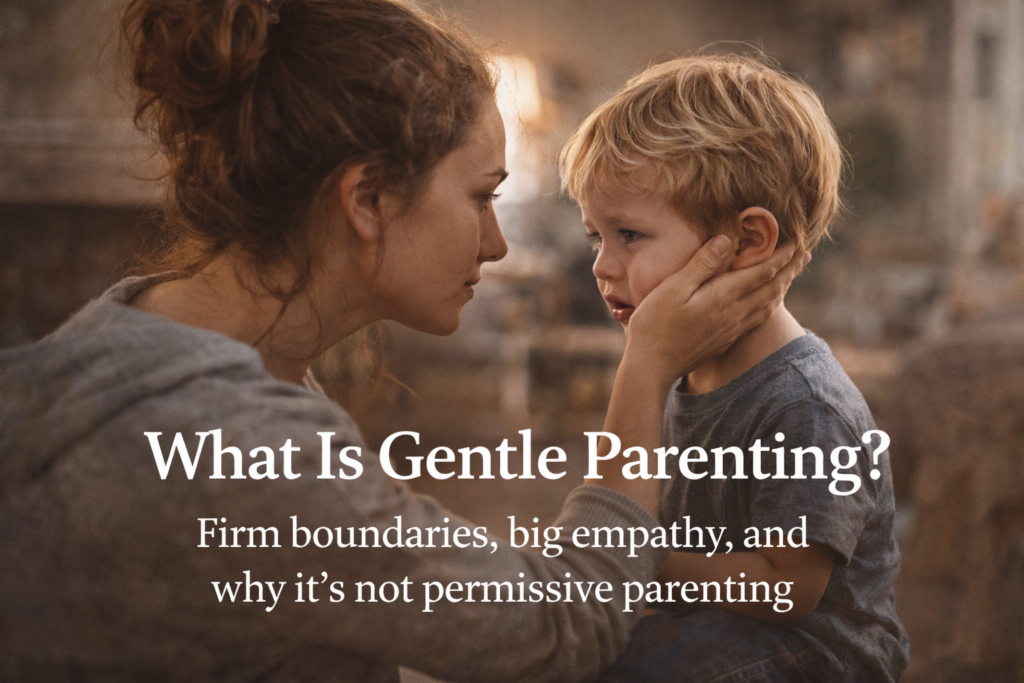
What Is Gentle Parenting? (And Why It’s Not “Letting Kids Do Whatever They Want”)
It is often misunderstood. This post breaks it down in a simple, real-life way, what it is, what it’s not, and how it differs from permissive parenting (with examples you can actually use).
If you’ve ever said “I’m trying Gentle Parenting, but my kid is walking all over me,”, you’re not alone. Most parents aren’t actually doing Gentle Parenting… they’re doing a mash-up of guilt, confusion, and fear of being “too harsh.”
And honestly? The internet doesn’t help. “Gentle” can sound like “soft.” “Kind” can sound like “no boundaries.” So people assume Gentle Parenting means: no consequences, no rules, and kids running the house.
Here’s the truth:
Gentle Parenting is not a lack of boundaries. It’s boundaries with connection, firm, clear, and respectful.
What Gentle Parenting Is Not
Let’s clear up the biggest myths first. Gentle Parenting is not:
❌ “Never saying no”
It includes clear limits. You can be kind and firm.
❌ “Letting feelings decide the rules”
Feelings are always allowed. Behaviors are not always allowed. It holds both.
❌ “Explaining for 20 minutes while your child spirals”
It is often fewer words, said calmly, at the right time.
❌ “No consequences”
Consequences still exist, just logical, safe, and not humiliating.
❌ “A perfect calm parent who never loses it”
It includes repair. You’re human. Your child learns from how you return.
Quick reframe
Gentle Parenting is not “gentle kids.” It’s a gentle approach, even when your child is loud, angry, or dysregulated.
What Gentle Parenting Actually Is
Gentle Parenting is a way of guiding children with respect, connection, and clear boundaries. It’s not about being soft. It’s about being steady.
Gentle Parenting in one sentence:
“I’m on your side… and I’m still the boundary.”
The 4 pillars
1) Connection first
Connection doesn’t mean you agree. It means your child feels seen, which lowers the emotional “volume.”
2) Clear, firm boundaries
You lead with calm authority: Consistent limits, repeated kindly, without threats or humiliation.
3) Emotion coaching
You help them name feelings and move through them, without letting feelings run the house.
4) Repair and resilience
When you mess up (because everyone does), you repair. That teaches accountability and safety.
Gentle vs Permissive Parenting (The Difference People Miss)
Many people confuse Gentle Parenting with permissive parenting because both avoid harsh punishment. But they are not the same.
| Situation | Permissive Parenting | Gentle Parenting |
|---|---|---|
| Your child hits / throws | “It’s okay, they’re upset.” (Boundary unclear or delayed) | “I won’t let you hit. You’re mad. Hands are not for hitting.” (Boundary + calm follow-through) |
| Your child refuses to leave the park | “Okay… five more minutes… okay ten…” (Limit moves) | “You can be mad. It’s time to go. I’ll help your body.” (Limit stays + support) |
| Your child melts down in the store | Gives in to avoid the meltdown (child learns “big feelings = gets the thing”) | Validates + holds limit: “You want it. Not today. We can be sad and still say no.” |
| Your child breaks a rule | Inconsistent consequences or “I don’t know what to do” | Logical consequence + repair: “Markers are for paper. We clean the wall together.” |
The simplest way to remember it:
Permissive: “I don’t want you upset, so the limit disappears.”
Gentle: “You can be upset, and the limit still stays.”
What Gentle Parenting Looks Like in Real Life
It is not about long speeches. It’s about short, calm phrases with consistent action. Here are a few “real-life” patterns:
✅ You lead the moment
You don’t negotiate safety. You don’t hand over leadership to a dysregulated toddler. You stay steady.
✅ You validate without giving in
Validation sounds like: “You really wanted that.” It does not sound like: “Fine, okay, whatever.”
✅ You use logical consequences
If they throw the toy, the toy takes a break. If they spill the water, we wipe it together. Clear and fair.
✅ You repair after hard moments
“That was too loud. I’m sorry. Let’s try again.” Repair builds safety and models accountability.
Gentle Scripts You Can Copy (Firm + Kind)
If you freeze in the moment, you’re not alone. Save these and practice them once when you’re calm, so they’re easier to access when it’s hard.
When your child is angry:
- “You’re mad. I’m here.”
- “It’s okay to be angry. It’s not okay to hurt.”
- “I won’t let you hit. I’ll hold your hands if I need to.”
When you need to hold a boundary:
- “You don’t have to like it. The answer is still no.”
- “I hear you. And it’s still time to…”
- “I’ll help your body.”
When you’ve already raised your voice:
- “That was too loud. I’m sorry.”
- “You didn’t deserve that. I’m going to try again.”
- “We’re safe. I’m here.”
Important note
Scripts only work when paired with follow-through. If you say the boundary but don’t hold it, kids learn the boundary isn’t real.
Want support for the moments you’re about to lose it?
The Toddler Tantrum Survival Kit gives you calm scripts, quick resets, and “what to do next” steps, so you can stay firm without yelling.
Get the Toddler Tantrum Survival Kit →No shame. No perfection. Just support for real life.
Gentle FAQ
Does Gentle Parenting mean no consequences?
No. It means consequences are logical, safe, and focused on learning, not fear.
What if my child laughs / ignores me?
That usually means the boundary isn’t being held consistently yet. Gentle Parenting is kind words + calm action.
Is Gentle Parenting the same as “gentle discipline”?
They’re closely related. Both focus on teaching skills, holding boundaries, and building connection, without threats or shame.
What if I yell sometimes?
You’re not disqualified. Repair matters. Apologize, reconnect, and build a plan for your hardest moments.

Continue Learning (Gentle, Practical Support)
If this post clarified things for you, these resources can help you apply it in real, everyday moments.
🌱 From Calm Little Home
- The Toddler Tantrum Survival Kit – calm scripts and step-by-step support for the moments Gentle Parenting feels hardest.
🤍 Trusted Gentle Parenting Resources
- 30-Day Gentle Parenting Course – a structured, day-by-day way to build calm boundaries without yelling or guilt.
- Fund & Function – evidence-based support for nervous system health, emotional regulation, and resilience (for parents, too).
Some links above are affiliate links. We only share resources we genuinely trust and use.