
Calm Little Home · Gentle Parenting Guide
What Is Gentle Parenting? A Practical Guide to Boundaries, Discipline & Real Life
Gentle parenting is an approach that combines empathy and respect with clear boundaries, guidance, and follow-through. It is not about avoiding discipline, saying yes to everything, or keeping children happy at all costs. The goal is to guide behavior without fear or humiliation while staying warm, steady, and clearly in the parent role.
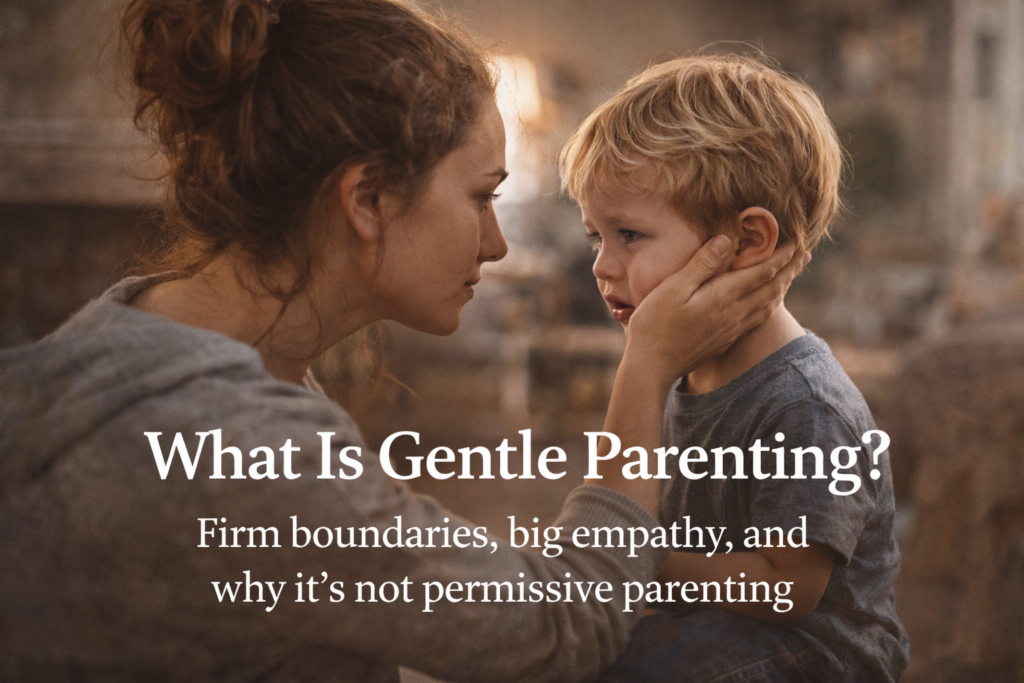
Short answer: gentle parenting is best understood as warm, respectful parenting that still includes limits. Your child can be angry with your decision, cry about it, or wish it were different, and the boundary can still stay. At Calm Little Home, we describe the practical version as Connect → Limit → Lead: acknowledge the experience, keep the boundary clear, then help the moment move forward.
The phrase gentle parenting is everywhere now. That can make it sound as if everyone agrees on one exact method. They do not. Gentle parenting is a popular, relatively new label rather than one tightly standardized clinical program. A 2024 peer-reviewed study described it as a multifaceted approach that commonly emphasizes parental affection, parent emotion regulation, helping children with emotions, and boundaries, while also finding that parents do not all practice those boundaries in the same way.
That distinction matters. If “gentle” becomes shorthand for never upset the child, parents can end up exhausted, over-explaining every decision, negotiating basic routines, and wondering why nothing feels steady. But if gentle parenting becomes only a softer tone wrapped around control, the connection piece disappears.
The useful middle is not softness versus strictness. It is warmth plus leadership.
What Gentle Parenting Actually Means
Gentle parenting usually centers on a few connected ideas: children deserve respect, emotions are not misbehavior, discipline should teach rather than humiliate, and parents should pay attention to their own tone and reactions. None of those ideas require the parent to step out of the leadership role.
Respect without surrender
Speak to your child like a person whose feelings matter. That does not mean every request becomes a yes.
Boundaries without fear
Use clear limits, predictable routines, and follow-through instead of threats, shame, or intimidation.
Teaching over humiliation
Show what to do, stop unsafe behavior, repair damage where possible, and teach when the child can actually receive it.
Repair over perfection
Parents lose patience. The goal is not never getting it wrong. It is noticing, repairing, and building a better plan for next time.
This fits comfortably with broader positive-discipline guidance from organizations such as the American Academy of Pediatrics, which emphasizes calm teaching, clear limits, consequences, and avoiding physical punishment or shaming. The CDC similarly emphasizes consistency, predictability, rules, routines, and follow-through for toddlers and preschoolers.
Gentle parenting is not parenting without boundaries.
It is the practice of holding boundaries without losing the relationship.
Gentle Parenting vs Permissive Parenting
This is probably the most important distinction to understand.
Gentle parenting and permissive parenting can both look warm. The difference becomes obvious when the child dislikes the limit.
In permissive parenting, the parent may repeatedly move the limit, avoid conflict, or remove the boundary because the child is upset. In gentle parenting, the parent can make room for the upset without handing the decision over to it.
| Situation | Harsh / controlling | Permissive | Gentle + firm |
|---|---|---|---|
| Leaving the playground | “Stop crying. We are leaving NOW.” | “Okay, five more minutes…” again and again | “You really wanted to stay. It is time to go. You can walk or I can help.” |
| Hitting after hearing no | Shame, yell, punish in anger | Ignore the hit or give the child what they wanted | “You are angry. I will not let you hit. I am moving back / blocking to keep us safe.” |
| Bedtime stalling | Threaten or abruptly withdraw connection | Keep adding books, snacks, games, and delays | “You want more time. Bedtime is still here. One hug, then lights out.” |
| Markers on the wall | Humiliate or use an unrelated punishment | Clean it up alone and move on | “Markers are for paper. I will put them away now. We will clean the wall together.” |
For a deeper comparison, read Gentle Parenting vs. Permissive Parenting: What’s the Real Difference?
The Calm Little Home Framework: Connect → Limit → Lead
One reason gentle parenting advice can feel frustrating is that it often stops after the validating sentence.
You are told to say, “You really wanted that.” Wonderful. But then your toddler is still screaming, still refusing shoes, still hitting, or still sitting in the sandbox when you have to leave.
That is why Calm Little Home uses three parts.
See the experience
“You really wanted to stay.”
Connection is not agreement. You are showing that you understand what is hard.
Keep the boundary clear
“It is time to go.”
No five-minute courtroom speech. The limit can be simple.
Help the moment move
“You can walk or I can help you to the stroller.”
Leadership is the part that turns a kind sentence into actual parenting.
Your child does not have to agree with the boundary for the boundary to be valid. They can protest. You can stay connected. And you can still follow through.
What Gentle Parenting Looks Like in Real Life
Gentle parenting gets much easier to understand when you stop treating it as a philosophy quiz and start looking at ordinary Tuesday-evening moments.
When your toddler screams because you said no
Connect: “You really wanted that.”
Limit: “The answer is still no.”
Lead: “You can be upset. I am here. We are going to put it back and keep moving.”
When your toddler hits
“You are angry. I will not let you hit.”
Then actually stop the hit: block, move back, move the object, or create space. Gentle parenting does not require you to tolerate unsafe behavior.
Read our deeper guide on what to do when your toddler hits without letting it slide.
When leaving the park becomes a full protest
“You wanted more playground time. It is hard to stop.”
“We are leaving now.”
“You can hold my hand or I can help you to the stroller.”
When bedtime keeps expanding
“You want one more book.”
“Books are finished for tonight.”
“You can choose one last cuddle or I can tuck you in now.”
See our guide to holding the bedtime boundary without turning it into a power struggle.
When you lose your temper
“I yelled. That was too loud, and I am sorry.”
“The boundary still matters. I am going to say it again more calmly.”
Repair is not the same as undoing the limit. Our guide to repairing after yelling at your toddler goes deeper.
Does Gentle Parenting Use Discipline and Consequences?
Yes. Gentle parenting is not “no discipline.” The word discipline can be useful when you think of it as teaching, structure, limits, and follow-through rather than punishment for punishment’s sake.
The American Academy of Pediatrics recommends strategies such as showing children what to do, setting clear limits, giving consequences, listening, and using calm attention and redirection. The CDC likewise emphasizes that family rules work best with consistency, predictability, and follow-through.
What a useful consequence looks like
A consequence is usually easiest for a young child to understand when it is immediate, connected to what happened, and delivered without humiliation.
Toy is being thrown at someone
“I will not let you throw it at people. The toy is taking a break for now.”
Water is dumped on purpose
“Water stays in the cup. We need to wipe this up together.”
Child keeps running in a parking lot
“I cannot let you run here. I am going to hold your hand / carry you to keep you safe.”
Bedtime book is being thrown
“Books need to stay safe. We are done with the book for tonight.”
The point is not to make the consequence painful enough that the child “learns a lesson.” The point is to make the boundary real, protect people or things, and teach what happens next.
What If Gentle Parenting “Doesn’t Work” and My Child Still Won’t Listen?
This question often hides an unrealistic test: If I say the gentle sentence correctly, will my child calmly agree?
Sometimes yes. Often no. A toddler can understand you and still dislike the answer. They can hear the boundary and still need help following it.
That does not automatically mean the approach failed.
Success is not always “my child stopped being upset.”
Sometimes success is: the limit stayed clear, everybody stayed safe, and the parent helped the situation move forward without shame or intimidation.
If you find yourself repeating the same request ten times and then yelling, the missing piece is often not a kinder phrase. It is earlier follow-through. Read how to get your toddler to listen without yelling or repeating yourself ten times.
Does Gentle Parenting Work? What the Evidence Can — and Cannot — Tell Us
This is an area where parenting websites should be careful.
Gentle parenting is a popular label, but the label itself has not been studied for decades in the same way as long-established parenting-style frameworks. In 2024, researchers published what they described as the first systematic investigation of gentle parenting as a self-identified approach. In their sample of 100 parents of children ages 2–7, self-identified gentle parents commonly emphasized regulating their own emotions, helping children with emotions, affection, and boundaries. The study also found meaningful variation in how those boundaries were enacted and noted parenting uncertainty and burnout among some participants.
So it would be too strong to say, “science proves gentle parenting works.”
What we can say is that many practices associated with gentle parenting overlap with much broader guidance that has stronger evidence and institutional support: warm relationships, clear limits, consistent rules, predictable routines, nonviolent discipline, modeling, and age-appropriate teaching.
That is the standard CLH tries to follow: use the gentle-parenting label as practical shorthand, but do not turn it into a promise of perfect outcomes or pretend every social-media claim is established science.
Benefits — and Challenges — of Gentle Parenting
Parents are often drawn to gentle parenting because they want less fear, yelling, shame, or power struggle in the home. The approach can give families a language for empathy, repair, and respectful boundaries.
But it can also become exhausting when parents believe they must remain perfectly calm, explain every limit until the child agrees, or prevent every disappointment.
| Potential strength | Common trap | CLH reframe |
|---|---|---|
| More attention to feelings | Feelings start deciding the rule | Feelings are welcome; the boundary can stay. |
| Less punitive discipline | Parent becomes afraid to use consequences | Use logical, connected follow-through. |
| More explanation | Every limit becomes a lecture | Use fewer words during the hard moment; teach later. |
| Parent self-regulation | Parent believes anger itself means failure | Notice, reset, repair. Perfection is not the goal. |
How to Start Gentle Parenting Without Overhauling Your Entire Life
You do not need a new personality, a 47-step morning routine, and a perfect script for every possible toddler crisis. Start smaller.
- Choose one recurring struggle. Bedtime, hitting, leaving the park, getting dressed, or hearing “no.”
- Decide the boundary before the hard moment. It is easier to stay calm when you already know what is and is not flexible.
- Choose one Connect sentence. “You really wanted…” or “You are disappointed.”
- Choose one Limit sentence. “The answer is no.” “I will not let you hit.” “It is time to leave.”
- Choose the Lead step. What will you actually do if your child cannot follow the direction alone?
- Repair when needed. If you yell, snap, or handle it badly, apologize for your behavior without pretending the original boundary was wrong.
Then repeat. Toddlers learn through repetition much more than through one beautiful speech.
Frequently Asked Questions About Gentle Parenting
Is gentle parenting the same as permissive parenting?
No. Gentle parenting can include empathy and warmth while still using clear limits and follow-through. Permissive parenting is generally characterized by high warmth with weaker or less consistent boundaries.
Can you say no in gentle parenting?
Absolutely. The difference is not whether you say no; it is how you hold the no. You can be clear without shaming, threatening, or turning the child’s disappointment into a reason to reverse the decision.
Does gentle parenting use consequences?
It can. CLH favors consequences that are related to the behavior, understandable to the child, focused on safety or learning, and delivered calmly rather than as retaliation.
Is gentle parenting evidence based?
Some practices associated with gentle parenting overlap with evidence-backed positive parenting and discipline guidance. But “gentle parenting” itself is a newer and loosely defined label, so evidence about the label should not be overstated.
Is gentle parenting the same as authoritative parenting?
Not exactly. There can be overlap in warmth and boundaries, but gentle parenting is a newer popular label and is not simply another name for the established authoritative-parenting research category.
What age is gentle parenting for?
The principles can be adapted across childhood, but Calm Little Home focuses mainly on toddler and preschool years, when limits, transitions, big feelings, and adult follow-through show up constantly.
What if my toddler laughs when I set a boundary?
Do not make the facial expression the test of whether the boundary “worked.” Keep the limit simple and follow through on the action you said would happen.
What if I yell sometimes?
You have not failed some gentle-parenting entrance exam. Repair what belongs to you: name that you yelled, apologize, reconnect, and repeat the boundary more calmly if it still matters.
Build the Gentle Parenting Picture
This guide is the foundation. These articles take the most common questions one step deeper:
- Gentle Parenting vs. Permissive Parenting — where warmth ends and wobbly boundaries begin.
- Gentle vs. Authoritarian Parenting — guidance without fear-based control.
- Gentle Parenting vs. Attachment Parenting — similarities and differences.
- Tantrum vs. Meltdown — how to adjust your support when emotions get big.
- What to Do When Your Toddler Hits — gentle parenting without letting unsafe behavior slide.
- How to Repair After Yelling — because repair belongs in real-life gentle parenting.
Want the words ready before the next hard moment?
The free Calm Parent Script Pack gives you 25 practical phrases for meltdowns, hitting, refusal, transitions, and repair — gentle enough to protect connection, clear enough to keep the boundary.
Get 25 Calm Parent Scripts — FreeSources & evidence notes
- Pezalla AE, Davidson AJ. “Trying to remain calm…but I do reach my limit sometimes”: An exploration of the meaning of gentle parenting. PLOS ONE, 2024.
- American Academy of Pediatrics / HealthyChildren.org. What’s the Best Way to Discipline My Child?
- CDC. Tips for Relying on Routines and Rules.
- CDC. Tips for Creating Rules.
Calm Little Home provides educational parenting content, not medical or mental-health care. When we discuss research, we distinguish findings about the specific “gentle parenting” label from broader evidence on positive parenting, discipline, routines, and parent-child relationships.


Pingback: Public Meltdown - How Do I Stay Calm, and Without Shame?
Pingback: Gentle Parenting Is Way Too Soft! - Parents Miss This
Pingback: How to Prevent Toddler Tantrums Before They Even Start
Pingback: Gentle vs. Permissive: The Hidden Harm of Weak Boundaries
Pingback: Gentle vs. Authoritarian: The Hidden Cost of Fear-Based
Pingback: Gentle Parenting vs. Attachment Parenting: What’s the Difference? - Calm Little Home
Pingback: Gentle vs. Winging-It Parenting - Calm Little Home
Pingback: Gentle Parenting vs. Helicopter Parenting - Calm Little Home
Pingback: Gentle vs. Snowplow - Calm Little Home
Pingback: Gentle vs. Tiger - Calm Little Home
Pingback: Gentle vs. Uninvolved Parenting: What’s the Difference?