

How Shouting Affects Your Toddler’s Brain to Backfire
If you’ve ever caught yourself shouting at your toddler and then felt that heavy wave of regret… you’re not alone.
Most loving parents don’t want to yell. However, when you’re tired, overstimulated, and pushed past your limit, your body can flip into “emergency mode.”
So, this post isn’t here to shame you.
Instead, it’s here to gently explain what shouting at your toddler can do to their brain, body, and behavior, and then give you realistic tools to use instead.
Gentle reminder: You’re not a bad parent; you’re a human parent.
What matters most isn’t that you never mess up, it’s that you notice, you learn, and you come back.
What Happens in a Toddler’s Brain When You’re Shouting
In the moment, shouting at your toddler can feel like the only thing strong enough to “cut through” the chaos.
However, toddlers don’t experience shouting as “helpful urgency.” Their nervous system often experiences it as threat, even if you never mean it that way.
As a result, their brain shifts away from learning and toward survival. That means the part of the brain that can listen, cooperate, and problem-solve is much harder to access in that moment.
If tantrums are happening often, you may also love this companion read: Why Toddlers Have Tantrums + 5 Peaceful Ways to Manage Them.
1) Can Trigger Fight / Flight / Freeze
Shouting is loud, sudden, and intense. Therefore, your toddler’s nervous system may read it as danger, especially if they’re already tired, hungry, or overwhelmed.
This stress response can look like:
- More screaming (fight)
- Running away / refusing (flight)
- Going quiet, frozen, or “zoning out” (freeze)
So even if your goal is to stop the behavior, shouting at your toddler can make them less able to cooperate, because their body is busy protecting itself.
2) Can Make the Meltdown Bigger
Many toddler meltdowns begin with an unmet need: hunger, tiredness, transition stress, sensory overload, or frustration.
However, when you add shouting on top of an already overwhelmed body, you add more intensity to a system that was already maxed out.
As a result, you may see:
- longer tantrums
- more stuck loops (whining, repeating demands)
- more “nothing works” moments
If you want gentle prevention (so tantrums reduce over time), this post is a great next step: Everyday Habits That Gently Reduce Toddler Meltdowns.
3) Can Teach “Loud = Power”
Toddlers learn by watching. So, they don’t just learn what you want; they learn how you handle frustration.
Therefore, when shouting becomes the go-to tool, your toddler may learn:
- “When I’m upset, I get louder.”
- “To be heard, I need to escalate.”
- “Big feelings are handled with big volume.”
Meanwhile, what we’re trying to teach is the opposite: “I can be upset and still be safe.”
4) Can Create a Moment of Disconnection
Even in very loving homes, shouting often creates a quick emotional “gap.”
Your toddler might not think, “My parent is stressed.” Instead, they may feel: “This is scary. I’m alone.”
Not because you’re a scary parent, but because toddlers read tone as safety.
If you want a clear, research-based explanation of why responsive connection matters so much for child development, Harvard’s “Serve and Return” overview is a great read: Harvard Center on the Developing Child: Serve and Return.
5) Can Increase Power Struggles Over Time
This part is hard, but important.
When shouting becomes frequent, the relationship can start to feel like a “who wins” tug-of-war.
As a result, you may notice:
- more arguing and “NO!” spirals
- more testing limits (because the limit feels emotional)
- more resistance during transitions
Instead of learning cooperation, your toddler learns escalation.
And meanwhile, you feel more exhausted, because you’re parenting on adrenaline.
6) Can Create a Shame Loop for You
After shouting at your toddler, many parents feel guilt, sadness, and that heavy thought: “What is wrong with me?”
However, shame doesn’t usually create better parenting; it creates more stress.
And stress makes shouting more likely next time.
So if you’re stuck in a shout → guilt → shout cycle, it doesn’t mean you’re broken.
It often means you’re overloaded and under-supported.
If your child pushes every button you have, this post will help: How to Stay Calm When Your Toddler Pushes Every Button You Have.
7) “But My Parents Did it…”
You might hear: “My parents yelled, and I turned out fine.”
However, parenting isn’t about proving we survived. It’s about choosing what helps our kids thrive.
In many families, shouting at your toddler may stop behavior in the short term, but it rarely teaches the long-term skills we actually want: emotional regulation, cooperation, and problem-solving.
So if you’re choosing a different way, that’s not “soft.” It’s brave.
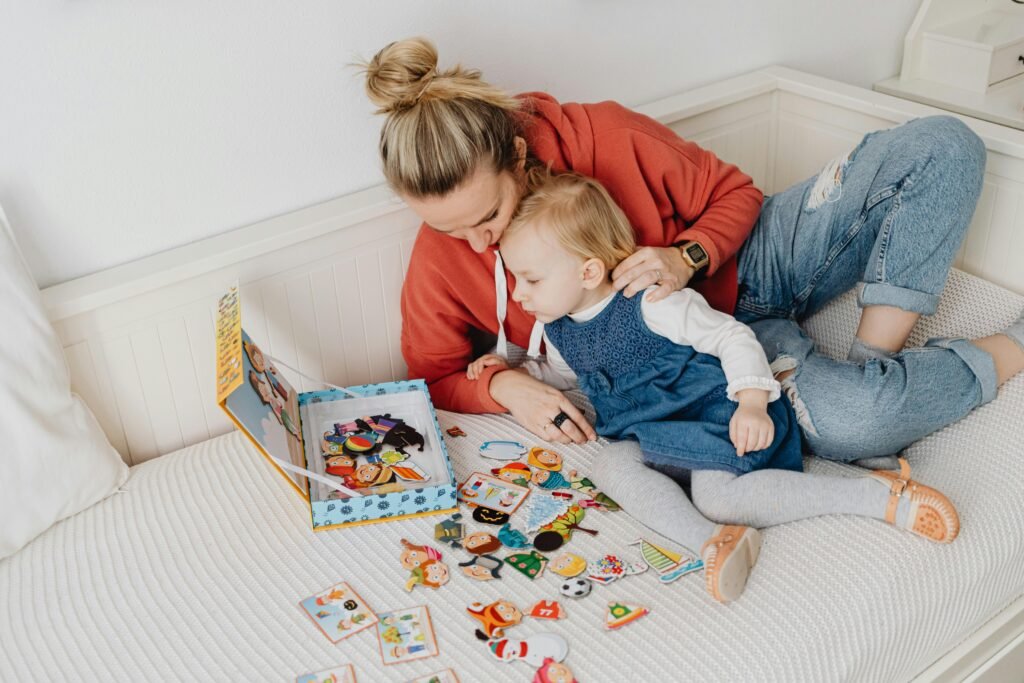
Here Is What to Do Instead of Shouting at Your Toddler
Now for the hopeful part.
You don’t have to go from “I shouted today” to “I never shout again” overnight.
Instead, you can build a replacement plan, so your nervous system has another path when stress hits.
Step 1: Catch the Moment Before Shouting at Your Toddler
The fastest way to reduce shouting is to notice the early signs in your body.
For example: tight jaw, hot face, fast talking, sharp thoughts, clenched hands.
As soon as you notice one sign, use a pause phrase:
- “I need a moment.”
- “I’m getting frustrated. I’m going to breathe.”
- “We’re safe. I’m going to slow down.”
Then take one slower breath in… and a longer breath out.
Even so, if safety is involved, safety comes first. You can block hitting, move objects, or create space, while still staying brief and calm.
Step 2: Replace Shouting With Gentle Phrases
This is where the pattern truly changes: you replace the “shout script” with a calm one.
Gentle phrases work because toddlers can process them, especially when they’re dysregulated.
And because you’re repeating the same phrases, you stop improvising under stress.
Here’s your full library of gentle phrases for tantrums, boundaries, transitions, unsafe moments, and repair:
How Gentle Phrases Will Help You Stay Steady In the Storm
Meanwhile, here are three starter phrases you can use today:
- Tantrum: “You’re having a hard time. I’m here.”
- Boundary: “I won’t let you. I will help you.”
- Reset: “Let’s try again.”
Step 3: Use Calm Leadership Instead of Shouting at Your Toddler
When you’re stressed, it’s easy to explain and explain… and then shout when it doesn’t work.
Instead, try fewer words and more follow-through.
For example:
- “I won’t let you hit.”
- “The answer is still no.”
- “You can be upset. The limit stays.”
Then follow through calmly. The follow-through teaches the boundary; your volume doesn’t have to.
Step 4: Use Regulation Tools to Prevent Shouting at Your Toddler
Sometimes the reason you shout isn’t “lack of patience.”
It’s overload.
Therefore, reducing shouting often means reducing the stressors around you, especially during your hardest time of day.
A few realistic supports:
- snack + water before the meltdown window
- fewer transitions (or more warnings)
- lower background noise
- a quick “reset routine” (water, pressure hug, wall push, quiet corner)
Also, many families find sensory tools helpful for calming big feelings and preventing escalation.
Affiliate disclosure: This link may earn a small commission for Calm Little Home at no extra cost to you. I only share tools that support gentle, connection-first parenting.
See sensory tools that can support calm-down moments
Step 5: Repair After Shouting at Your Toddler
Here’s the truth: even gentle parents lose it sometimes.
However, what matters most isn’t that you never snap, it’s that you come back.
Instead of staying stuck in guilt, you repair, reconnect, and show your child that love returns after hard moments.
- “I didn’t like how I spoke. I’m sorry.”
- “You didn’t deserve that voice.”
- “I’m practicing staying calm. I’ll try again.”
- “Can we have a do-over?”
- “I love you, even on hard days.”
Then keep it simple: name what happened, name the boundary, and reconnect with closeness or a calm activity.
A 7-Day Plan to Reduce Shouting at Your Toddler
To make this practical, don’t try to “fix everything.”
Instead, pick one daily moment where shouting tends to happen (mornings, dinner, bedtime) and focus there.
- Choose 2 gentle phrases you’ll repeat all week.
- Pick 1 pause phrase for when you feel triggered.
- Choose 1 repair phrase for when you need a reset.
- Put them on a sticky note where you’ll see them.
- Practice once when calm (so you remember them under stress).
As a result, you build a new default pattern, without needing perfection.
Want Step-by-Step Support for the Next 30 Days?
If you want gentle parenting support that feels realistic (not perfectionistic), a simple daily guide can help you build calmer habits without overwhelm.
Affiliate disclosure: This link may earn a small commission at no extra cost to you. Thank you for supporting Calm Little Home.
30-Day Gentle Parenting Guide (A Kinder Way to Support Your Child and Yourself)
One Last Reminder (If You Feel Guilty)
If you were shouting at your toddler today, it doesn’t erase your love.
Even so, it’s okay to want to change the pattern.
Start small. Choose one gentle phrase. Practice one pause. Make one repair.
And if you need a reset, the most powerful words in a family are still: “Let’s try again.”

🌿 Keep Reading (Gentle Support for Fewer Meltdowns)
- How to Stay Calm When Your Toddler Pushes Every Button You Have — because sometimes the hardest part is what it triggers in you.
- Calm Scripts to Use When Big Feelings Take Over — so you don’t have to find the right words under pressure.
- 15 Gentle Reminders for Parents on Overwhelming Days — for the days you need comfort more than another “tip.”
- What Is Gentle Parenting? (And Why It’s Not Permissive Parenting) — a clear foundation that makes the habits in this post easier to apply.
Bring More Calm to Your Home
If you are looking for more ways to navigate the toddler years with confidence and steady leadership, explore our full library of resources. From the Calm Scripts Vault to the Toddler Tantrum Survival Kit, we have practical tools designed to support you in the hardest parenting moments.
Explore the Calm Little Home Shop— External Resources – We Recommend —
💛 Want step-by-step support instead of trying to remember everything at once?
If you’d like a gentle plan you can follow daily, the 30-Day Gentle Parenting Course walks you through calm scripts, emotional regulation tools, and simple routines — one small step at a time.
Start the 30-Day Gentle Parenting Journey →🧸 Extra support for sensory-heavy days
If your toddler melts down more when they’re restless or “wired,” sensory tools can help fill their cup (think: calm corners, busy hands, smoother transitions).
Explore Fun & Function Sensory Tools →